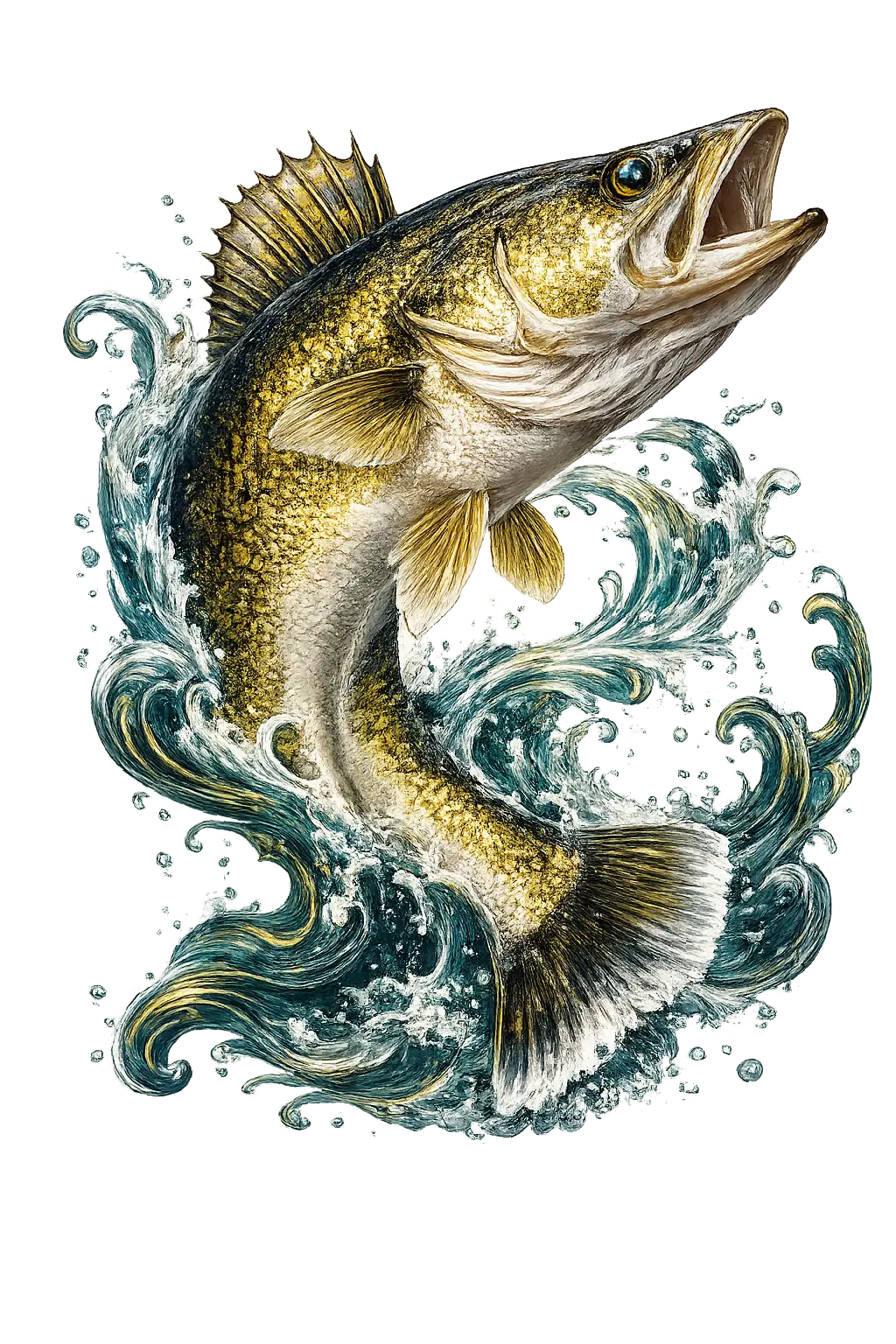
Walleye, Sauger, or Saugeye? How to Tell Them Apart
The tail, the fin, the markings — settle it in seconds.
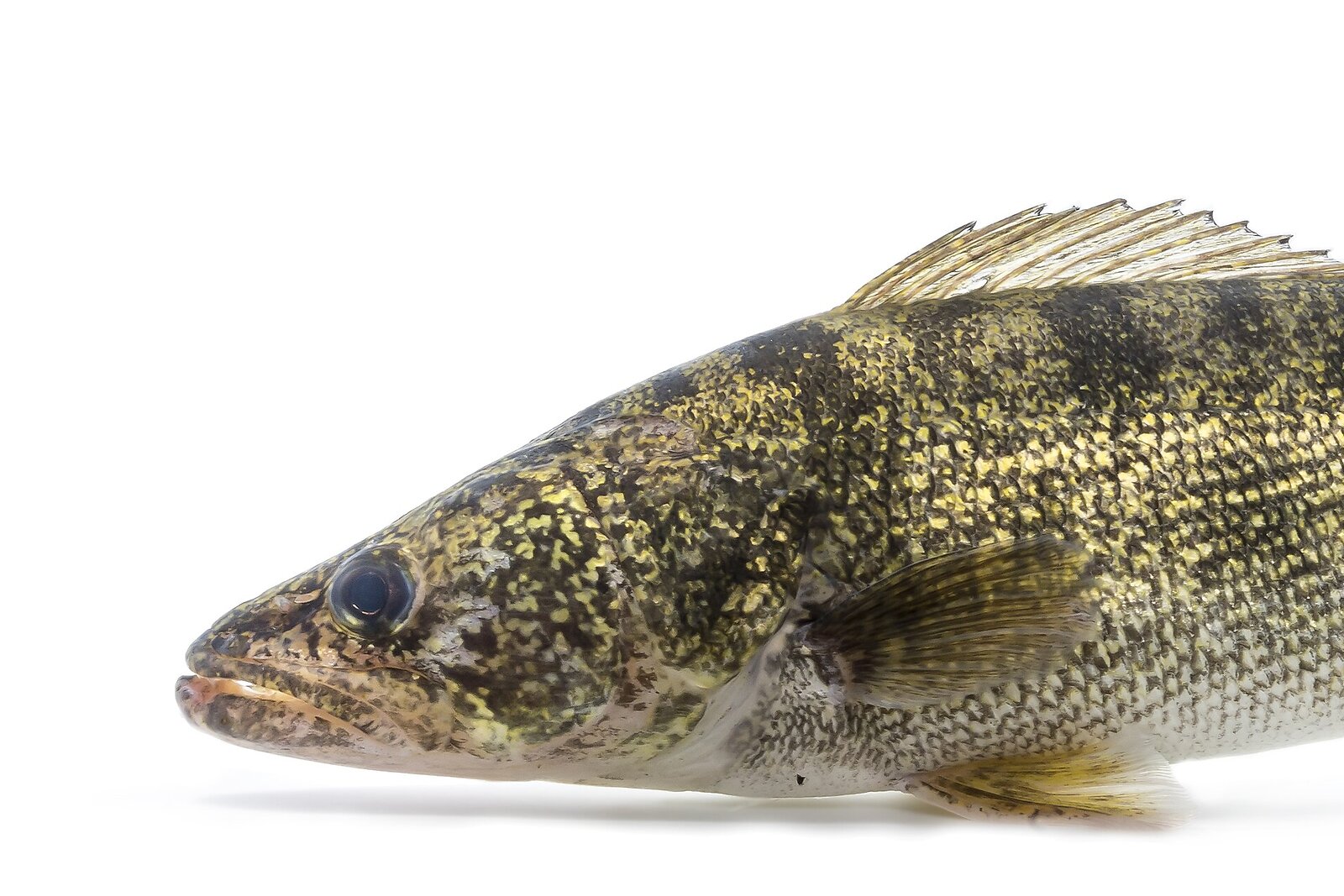
Walleye and sauger are separate, native North American fish; the saugeye is their hybrid. The quickest tells are the tail and the spiny (front) dorsal fin: a walleye has a white tip on the lower lobe of its tail and a mostly clear front fin with one dark blotch at the rear; a sauger has no white tail tip, distinct rows of dark spots on that fin, and dark saddle blotches across its back. The saugeye falls in between. Below is a side-by-side to settle it, plus where all three came from and which one eats best.
| Feature | Walleye | Sauger | Saugeye (hybrid) |
|---|---|---|---|
| Tail (lower lobe) | White / cream tip | No white tip; often spotted | Often a faint white tip |
| First (spiny) dorsal fin | Membrane mostly clear; dark blotch at rear base | Distinct rows of dark spots | Spots and a blotch — intermediate |
| Body markings | Mottled brassy / olive | 3–4 dark saddle blotches | Saddle-like, blotchy — intermediate |
| Cheek scales | Smooth / sparsely scaled | Rough / well scaled | Intermediate |
| Typical size | Larger — to ~30 in. | Smaller — to ~15 in. | Intermediate; fast-growing |
| Preferred water | Cool, clear lakes & rivers; rock | Turbid rivers; deeper, murkier water | Turbid reservoirs (its strength) |
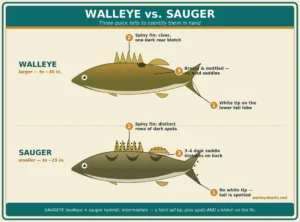
How to tell a walleye from a sauger in hand
Work three tells in order and you’ll settle almost every fish. First, the tail: flip the fish and look at the bottom lobe of the tail fin — a walleye wears a clean white or cream tip there; a sauger doesn’t (its tail is plain or lightly spotted). Second, the spiny front fin: a sauger’s is marked with neat rows of dark spots, while a walleye’s membrane is mostly clear except for one dark blotch at the very back. Third, the body: sauger show three or four bold dark “saddles” straddling the back; a walleye is more evenly mottled brassy-olive. Sauger also run smaller and have rougher, better-scaled cheeks.
Saugeye are the honest exception: because they’re a walleye-sauger cross, they read intermediate — a faint tail tip, spots and a blotch on the fin, blotchy sides. A truly ambiguous fish may only be settled by genetics, and in many stocked reservoirs the “walleye” you catch is actually a saugeye. For where each fish holds and feeds, see our walleye habitat guide.
Where walleye, sauger, and saugeye came from
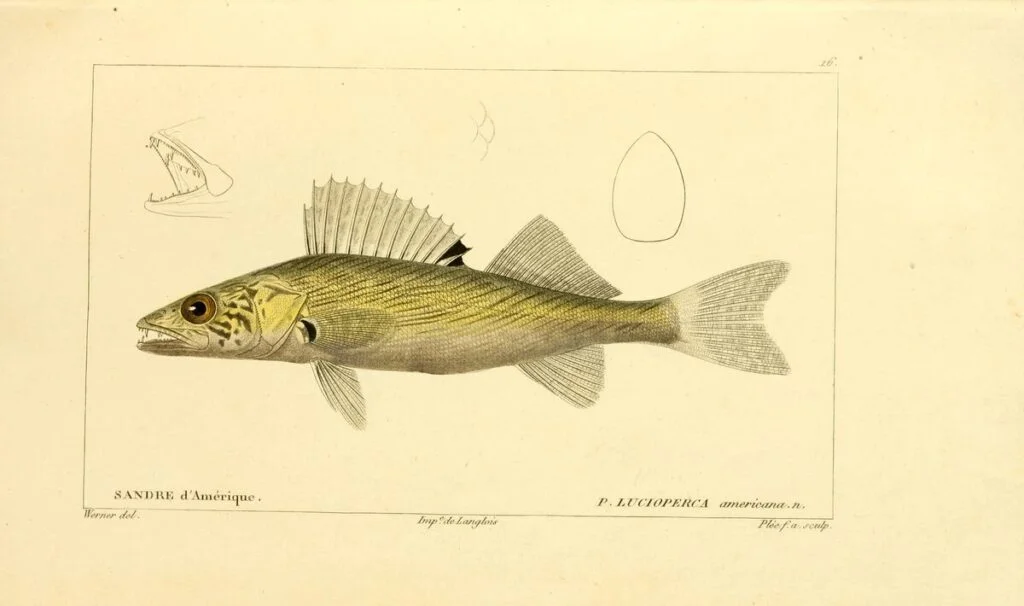
Two ancient cousins
Walleye and sauger aren’t parent and variant — they’re long-separated sister species, both native North American members of the perch family (Percidae). Molecular clocks put their split at roughly three million years ago (estimates land around 2.75–3.1 million years), during the Pleistocene. Their nearest relative overseas is the European zander (Sander lucioperca) — the same “pike-perch” lineage — so the family tree reaches across the Atlantic.
Shaped by the Ice Age
Much of today’s range was carved by glaciation. As the ice sheets advanced and retreated, walleye survived in a handful of ice-free refuges; genetic studies of their mitochondrial DNA resolve three main lineages — broadly an Atlantic, a Mississippian, and a Missourian stock — from which walleye recolonized the thawing north roughly 8,000–10,000 years ago. A great deal of the modern map is that post-glacial spread, layered over more than a century of stocking.
The name saga
Even the official name has a backstory. For most of the last two centuries walleye and sauger sat in the genus Stizostedion (Rafinesque, 1820), the name generations of American anglers grew up with. Scientists later moved them to the older, technically senior name Sander (Oken, 1817), formally adopted by the American Fisheries Society in 2003. Taxonomists still argue about it — a 2021 paper contended that “Sander” was improperly lifted from a common name and that Stizostedion should stand, and a 2022 reply pushed back. Proof that even a fish’s Latin name has history.
The newcomer: the saugeye
The saugeye is the hybrid of a female walleye and a male sauger. It happens naturally wherever the two species overlap, but it’s mostly a human creation — hatcheries have mass-produced it since the late 20th century for put-and-take reservoir fisheries because it grows fast and tolerates turbid, fertile water better than pure walleye. Ohio alone stocks it by the tens of millions each year. One myth worth busting: hybrids are often assumed sterile, but saugeye are fertile — a 2025 study documented them producing viable young with both parent species and with other saugeye. It’s exactly why some agencies won’t stock saugeye in reservoirs that drain toward wild walleye water.
Which is best to eat — and to catch?
On the plate, it’s essentially a tie: walleye, sauger, and saugeye all give the same mild, sweet, flaky white fillet, and most people can’t tell them apart cooked — try any of them with our walleye recipes. To catch, all three hit the same presentations (jigs, live-bait rigs, and crankbaits), so gear up the same way: browse walleye jigs and walleye lures. The saugeye is the standout sport fish of the three — it fights hard, grows fast, and keeps biting in the stained water that shuts down a purebred walleye, which is why reservoir anglers prize it. For timing and location, see our walleye fishing tips.
Walleye vs. Sauger vs. Saugeye FAQ
What’s the difference between a walleye and a sauger?
They’re separate, closely related species. The fast tells: a walleye has a white tip on the lower lobe of its tail and a mostly clear spiny fin; a sauger has no white tail tip, rows of dark spots on that fin, and three to four dark saddle blotches on its back. Walleye also grow larger (to ~30 in.) than sauger (to ~15 in.).
What is a saugeye?
A saugeye is the hybrid of a female walleye and a male sauger. It occurs naturally where the two overlap, but most saugeye are produced in hatcheries and stocked into reservoirs because they grow fast and thrive in turbid, fertile water.
How can you tell a saugeye from a walleye?
It’s genuinely hard, because saugeye look intermediate. Compared with a walleye, a saugeye usually shows a fainter (or absent) white tail tip, both spots and a blotch on the spiny fin, and blotchy, saddle-like sides. Truly ambiguous fish sometimes require genetic testing to confirm.
Is a saugeye a natural fish or man-made?
Both. Saugeye hybridize on their own where walleye and sauger share water, but the fish anglers usually catch are hatchery-produced and stocked by state wildlife agencies — Ohio alone stocks tens of millions a year.
Are saugeye sterile?
No. Despite the common assumption that hybrids can’t reproduce, saugeye are fertile: research has documented them producing viable offspring with both parent species and with other saugeye. Because of that, some agencies avoid stocking them where they could breed with wild walleye.
Do walleye, sauger, and saugeye taste different?
Not really. All three yield the same mild, sweet, flaky white fillet, and most people can’t tell them apart once cooked. Any walleye recipe works for all three.
Where did walleye and sauger come from?
They’re native North American perch-family fish and long-separated sister species, splitting from a common ancestor roughly three million years ago; their closest overseas relative is the European zander. Their modern range was shaped by Ice-Age glaciation and, more recently, by stocking.
Identification graphic © Walleye Baits. Historical plate: “Sandre d’Amérique / Lucioperca americana” (Werner, Histoire Naturelle des Poissons, 1830s), public domain via Wikimedia Commons.
Sources: walleye–sauger divergence and sister-taxa relationship (environmental-DNA study, Sander); genus name history (American Fisheries Society, Sander vs. Stizostedion); saugeye fertility (North American Journal of Fisheries Management, 2025); saugeye biology and stocking (Ohio DNR); Walleye photo courtesy U.S. Fish & Wildlife Service (USFWS Mountain Prairie), public domain.